
ApplicationsAIAUDIT™

Audit your AI systemswith evidence.

Determine which requirements apply to each system, test controls and document audit decisions. From inventory to opinion, the audit record connects each step.
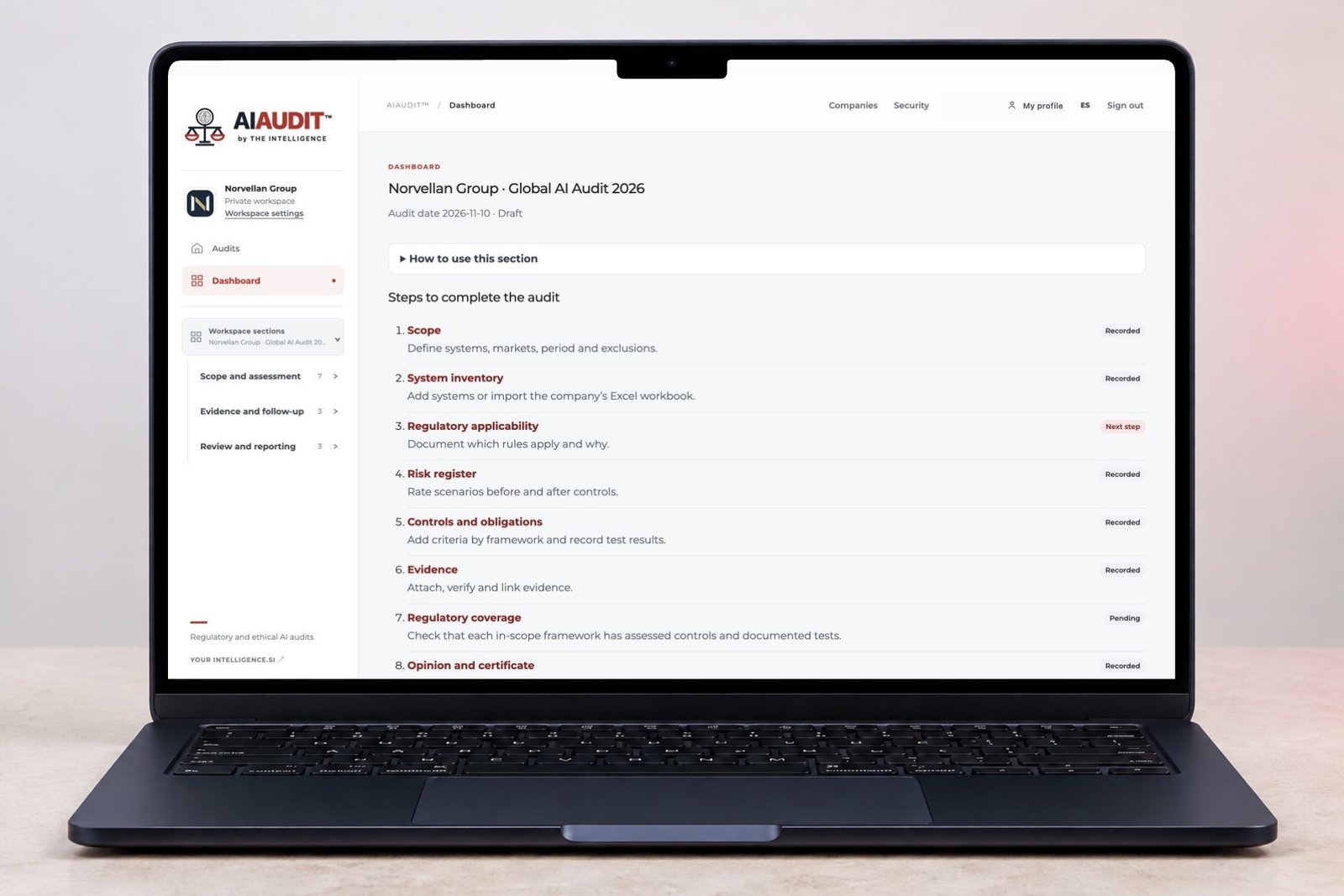
Norvellan Group audit dashboard in AIAUDIT
250
countries and territories for applicability review
Traceability
from criterion to test, evidence and finding
HTML · Word · PDF
formats for exporting the audit

How an audit works

Explore the Norvellan Group audit screens and follow the team’s work from scope to report.

Define what you will audit

Open an audit for the organisation, set its scope and schedule, and identify each system, its purpose and the people responsible for overseeing it.

Dashboard
Dashboard

See the status of the audit, outstanding steps and review progress.

Enlarge

Review requirements by system and market

The same tool can have different uses and obligations across markets. Record the activity, the organisation’s role, the source and the application date of each requirement.

Documented decisions

Record which rules apply, which are out of scope and which require confirmation or take effect later.

Coverage and official sources

Check which controls still need to be added or assessed. Consult sources and catalogue updates to decide when to reopen a review.

Marking and transparency

Document AI interaction notices, visible labels, machine-readable marking and provenance credentials. Test whether they persist when files are published or transformed.

AIAUDIT™ rules and frameworks

Global scope. Initial screening by country and territory. Obligations depend on the activity, market, system and each organisation’s role.

EU and national rules

  • EU AI Act (Regulation (EU) 2024/1689), as amended by (EU) 2026/1744
  • GDPR (EU) 2016/679 and LOPDGDD (Organic Law 3/2018)
  • AI transparency and marking · AI Act Articles 50 and 111(4)
Rules and references by country or sector

Reviewed where relevant to the jurisdiction, sector and application date.

European Union
NIS2 (Directive (EU) 2022/2555) · DORA (Regulation (EU) 2022/2554)
United States · federal
Federal Trade Commission Act, section 5
United States · California
CCPA Regulations (11 CCR) on risk assessments and automated decisionmaking technology
United States · Colorado
SB26-189 on automated decision-making technology
United States · New York City
Local Law 144 of 2021 and 6 RCNY §§ 5-300–304 on automated employment decision tools
United Kingdom
UK GDPR and Data (Use and Access) Act 2025 · Network and Information Systems Regulations 2018 (SI 2018/506)
Canada · federal
PIPEDA (S.C. 2000, c. 5) · Directive on Automated Decision-Making (federal administrative policy)
Canada · Quebec
Act respecting the protection of personal information in the private sector (P-39.1)
China
PIPL (2021) · Interim Measures for Generative AI Services (Order No. 15, 2023) · AI-generated content labelling measures (2025) · GB 45438-2025 marking standard
South Korea
AI Basic Act
Singapore
Personal Data Protection Act 2012 (PDPA)
Australia
Privacy Act 1988 and Australian Privacy Principles · Privacy and Other Legislation Amendment Act 2024 on automated decisions
Japan
Act on the Protection of Personal Information (APPI)
India
DPDP Act 2023 and Rules 2025
South Africa
POPIA, Act 4 of 2013
Maritime sector
IMO (International Maritime Organization) maritime cyber risk (MSC.428(98), guidance and ISM Code)
Brazil
Lei Geral de Proteção de Dados Pessoais (LGPD, Lei 13.709/2018)
Mexico
Federal Law on Protection of Personal Data Held by Private Parties (2025)
Colombia
Law 1581 of 2012 · SIC External Circular 002 of 2024
Chile
Law 19.628 · Law 21.719
Argentina
Personal Data Protection Law 25.326
Peru
Law 29.733 and Supreme Decree 016-2024-JUS · AI Law 31.814 and Supreme Decree 115-2025-PCM
Uruguay
Personal Data Protection and Habeas Data Law 18.331
Ecuador
Organic Law on Personal Data Protection · General Regulation (Executive Decree 904)
Costa Rica
Personal Data Processing Protection Law 8968
Panama
Law 81 of 2019 and Executive Decree 285 of 2021
Voluntary frameworks and technical references
  • NIST AI RMF 1.0 (AI 100-1) · Generative AI Profile (AI 600-1) · synthetic content (AI 100-4)
  • European AI Office Code of Practice on Transparency of AI-Generated Content
  • Singapore PDPC guidance on personal data in AI recommendation and decision systems · Japan’s AI Guidelines for Business (MIC/METI)
  • OECD AI Principles · ISO/IEC 42001 · ISO/IEC 23894 · C2PA / Content Credentials · THE INTELLIGENCE AI Assurance (internal criteria)
Sign in to AIAUDIT™

AIAUDIT™ · GLOBAL COVERAGE

World map of AI regulation

Explore the rules AIAUDIT™ can assess based on the market, the system and your organisation’s role.

250 countries and territories57 with references in the catalogue193 covered by initial applicability screening
Identified references Initial screening

Hover over the map or select a territory to keep its details open.

United Kingdom of Great Britain and Northern Ireland. 2 identified references.

A report that shows the basis for each conclusion

The report includes the executive summary, applicability, inventory, risks and assessed controls. It also shows evidence references, findings, accreditation and the audit opinion.
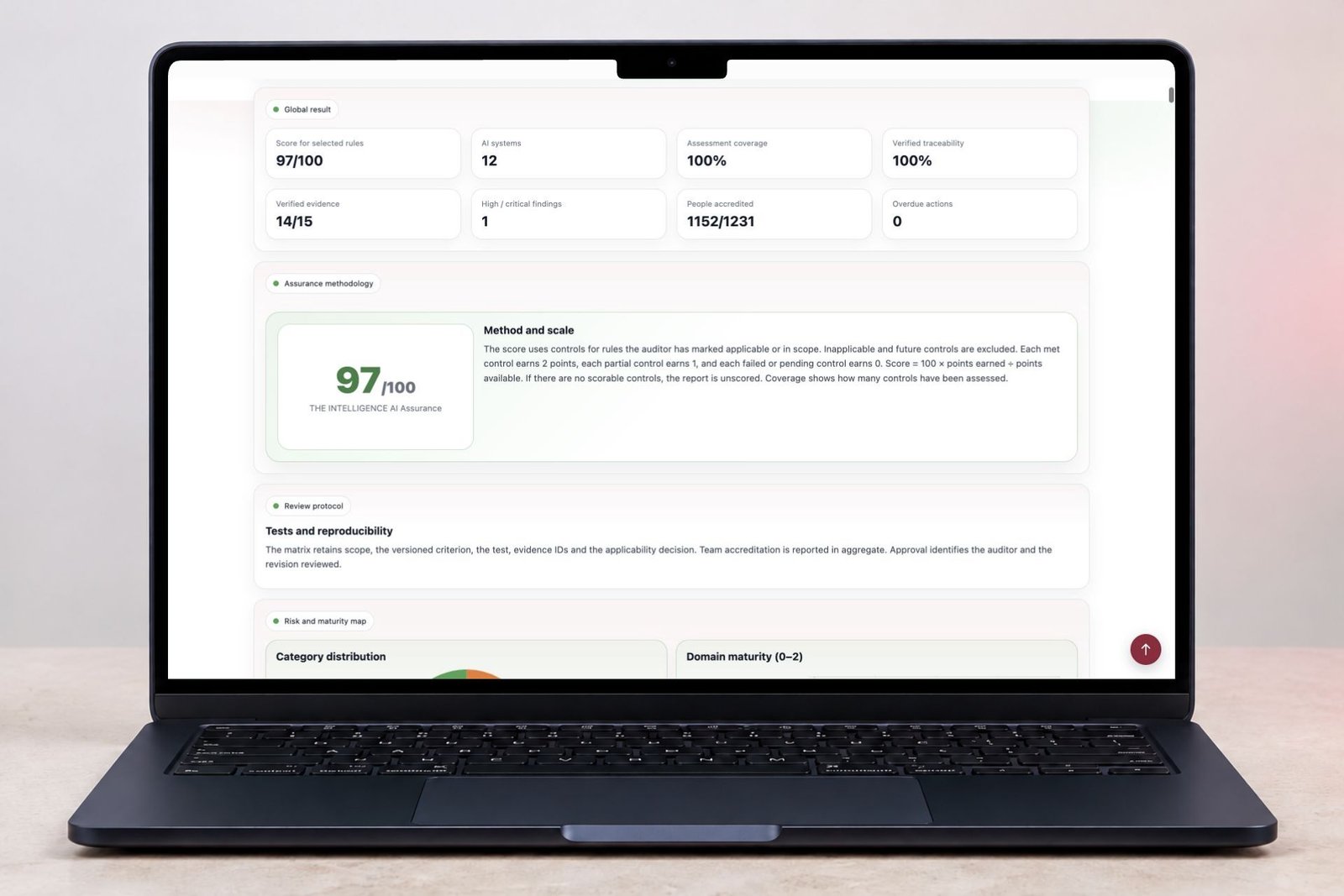
  • Scoring, coverage and traceability indicators with their calculation method.
  • Findings with corrective measures, owners and follow-up dates.
  • Standalone bilingual HTML, Word and PDF exports. Evidence files remain accessible in the private audit workspace.
Score, coverage and traceability in the Norvellan Group sample report

Questions about AIAUDIT

What information should we provide?

Descriptions of AI uses, the people responsible, available documentation and control and oversight practices. The review scope determines which evidence is needed.

How are the criteria selected?

Start with the specific use of the system and the context of your organisation. The review team documents the compliance and ethical criteria it examines and the evidence behind its assessment.

Can I start from an existing inventory?

Yes. Import systems from Excel and add or update their purpose, owner, provider, classification and other details in the audit.

What can I share at the end of a review?

Export the report as standalone HTML, Word or PDF. The report retains references to supporting evidence. Original files are available in the private audit workspace.

How do I keep the audit up to date?

The catalogue displays sources and updates. Review changes, add relevant criteria and record new assessments to preserve what was reviewed and when.

Who reviews the conclusions?

The people responsible in your organisation check the information, review findings and decide on actions. Traceability lets them return to the criterion and evidence behind each conclusion.

LET’S DISCUSS YOUR ORGANISATION

Bring structure to your AI review.

Tell us which systems you use and what you need to review.